
What We Manage
-
The Los Angeles County Sanitation Districts (often called the “Sanitation Districts”) are a regional public agency created in 1923 under state law. They provide wastewater (sewage) and solid waste (refuse) services to more than 5.6 million people across 78 cities and unincorporated areas of Los Angeles County.
The Sanitation Districts are made up of 24 independent special districts that operate under a joint administration agreement and share a single staff. Each district is governed by a Board of Directors made up of the mayors from its member cities and the Chair of the Los Angeles County Board of Supervisors for unincorporated areas.
-
The Sanitation Districts operate and maintain more than 1,400 miles of sewers and 47 pumping plants that convey over half of Los Angeles County’s wastewater (sewage) to 11 wastewater treatment plants. Approximately 400 million gallons of wastewater are treated each day at these facilities. Ten plants are located inland and are known as water reclamation plants (WRPs), which produce highly treated water for uses such as landscape irrigation and groundwater replenishment. The A.K. Warren Water Resource Facility (formerly known as the Joint Water Pollution Control Plant) in Carson is the Sanitation Districts’ largest facility, with a treatment capacity of 400 million gallons per day (mgd). It currently treats about 260 mgd and discharges treated water to the ocean through two tunnels and an outfall system.
-
The Joint Outfall System (JOS) serves about 5 million people in the lower and eastern portion of LA county. The system is designed so that inland water reclamation plants (WRPs) treat lower-salinity (less salty) wastewater for local reuse. Solids removed during treatment at the WRPs are returned to the sewer system for centralized treatment at the Warren Facility. This system design helps reduce costs to ratepayers.
About the New Tunnel
-
In 2012, the Sanitation Districts’ Board of Directors approved the Clearwater Project to protect local waterways and address aging infrastructure. The project includes a new tunnel to convey treated water from the A.K. Warren Water Resource Facility in Carson to existing ocean outfalls at Royal Palms Beach on the Palos Verdes Peninsula. It follows a multi-year planning and environmental review process that began in 2006 to ensure the Joint Outfall System remains reliable and has sufficient capacity through 2050.
-
During an evaluation of the Joint Outfall System, several concerns were identified with the existing tunnels that carry treated water to the ocean:
Insufficient flow capacity during storms: Rainstorms increase flows in the sewer system, causing higher than normal flows. The existing tunnels nearly reached their capacity twice during major storms, most recently in January 2017.
Risk of structural failure due to age: The tunnels, built in 1937 and 1958, cannot be taken out of service for inspection or repair because they must continuously carry flow.
Risk of collapse due to an earthquake: The existing tunnels are not built to current seismic standards, yet they cross two earthquake faults.
The existing tunnels are a critical part of the JOS, and their reliability is essential for protecting public health and the environment. Structural failure or limited tunnel capacity could result in partially treated or untreated wastewater being discharged to nearby waterways, causing long-term environmental damage. The new Clearwater Tunnel will help protect surrounding waterways by addressing these concerns.
-
In 2006, the Sanitation Districts began a multi-year planning effort to identify improvements needed to ensure Joint Outfall System reliability and capacity through 2050. A key concern was the capacity of the existing tunnels. Alternatives were evaluated, including one that involved large-scale water recycling at the Warren Facility (formerly JWPCP) to reduce tunnel flows and allow the tunnels to be upgraded one at a time. This option was found to be infeasible. The alternative with a new tunnel was the highest-rated, feasible solution.
Twenty-two tunnel alignments were evaluated, and over 500 public outreach meetings were held. Based on this review, the tunnel alignment with the least environmental impact and lowest cost was selected by the Board of Directors in 2012.
After the Clearwater Project was approved, the Regional Recycled Water Project at the Warren Facility was proposed. A 2016 technical review confirmed that a new tunnel would still be necessary to protect public safety and the environment. An independent review by the Los Angeles County Department of Public Works in 2017 concurred with this determination.
-
Yes. The new tunnel will carry cleaned wastewater from the A.K. Warren Water Resource Facility in Carson to the existing ocean outfalls at Royal Palms Beach. The quality of the water being transported will remain the same as it is today, and the project will maintain current treatment and discharge standards. The only change is how the water is conveyed, using a more reliable and seismically resilient system.
Financing
-
Approximately $700 million, which includes design and construction management costs.
-
The Clearwater Project is funded through existing capital reserves and long-term financing, repaid via service charges (residential/commercial) or industrial wastewater surcharges. Spreading costs over many years limits rate impacts. The current system-wide average service charge is $163 per year per single-family home, among the lowest nationally. With existing debt soon paid off, the project’s new debt adds only a one-time increase of $5–$7 per year.
Tunnel Construction
-
2006 - 2018 Planning and Design
2019 - 2027 Beginning in Carson, construction is currently underway and progressing through Royal Palms Beach.
2027 The project will be finalized and all construction sites will be restored to their original conditions.
*Note: These dates are all subject to change
-
The tunnel will be built using a state-of-the-art, multimillion-dollar tunnel boring machine (TBM) specifically designed for this project. It will mostly run under public streets and will not pass under any homes. At depths of 30 to 450 feet, tunneling will produce no noticeable vibration or noise at the surface. An extensive geotechnical monitoring system with over 1,000 locations along the alignment will track ground movement. If any movement is detected, tunneling will be slowed or stopped, and the TBM adjusted.
The project is designed to minimize community impacts by limiting construction to two sites for tunnel access shafts. At the Warren Facility shaft, the TBM and materials will be lowered into the ground, and excavated soil removed, with barriers to reduce visibility and noise. A smaller exit shaft at Royal Palms Beach will remove the TBM and connect the new tunnel to existing ocean outfalls, with visual and noise barriers in place. Work will be confined to a small area, and the beach will remain accessible.
The project’s Environmental Impact Report/Statement (EIR/EIS) identified potential impacts and required mitigation measures, which the Sanitation Districts will implement, including using modern, clean-engine trucks.
-
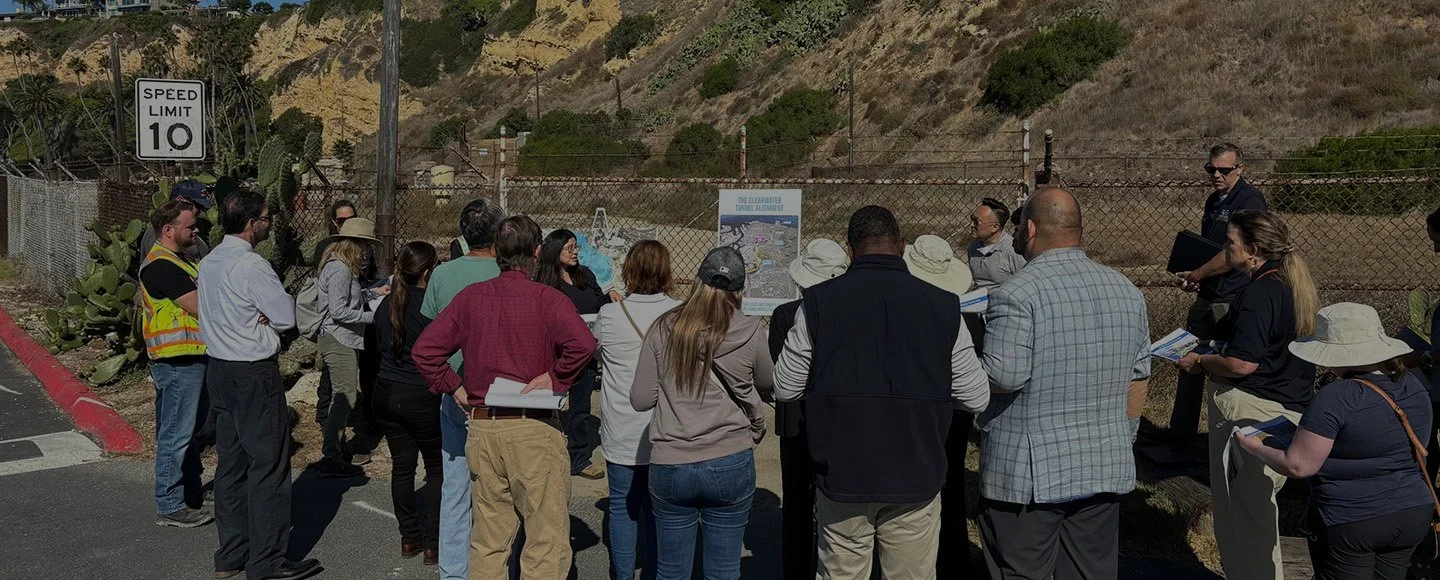
The new tunnel alignment follows public streets as much as possible to avoid passing under homes and businesses. It will start under the west side of the Warren Facility (formerly JWPCP), then run beneath Figueroa Street, Harbor Regional Park, North Gaffey Street, Capitol Drive, and Western Avenue (through South Dodson Avenue), ending at Royal Palms Beach. The tunnel must pass under some commercial properties to make the turns from Gaffey to Capitol and from Capitol to Western.
At depths of 30 to 450 feet, impacts at street level are expected to be imperceptible. As a safeguard, an extensive geotechnical monitoring system along the alignment will track parameters such as vibration and settlement to ensure safety.
-
Most above-ground construction activity will occur at the Warren Facility and Royal Palms Beach shaft sites. Some locations along the tunnel alignment will also have short-term visible activity, such as installing the geotechnical monitoring system. In addition, three underground maintenance blocks needed for TBM cutting head maintenance will be constructed. Each block will take about three months to build using a drill rig that injects cement into the ground at the TBM’s depth.
-
Once completed, the project will have no impact on traffic. During construction, trips will be needed for workers, supplies, and removal of tunnel soil. At the Warren Facility shaft site, trucks will follow a route along Figueroa Street and Sepulveda Boulevard to the Harbor Freeway, avoiding residences. The EIR/EIS found these impacts to be less than significant. The Sanitation Districts will also coordinate with the cities of Carson and Los Angeles to further minimize the impact to the community.
-
The tunnel will be constructed entirely underground, except for the shafts at each end. Limited street work will be needed to install and later remove the geotechnical monitoring system, and this work will occur during off-hours to minimize impacts. No road closures are required.
-
Modern tunnel boring machines (TBMs) provide a highly controlled tunneling process and are widely used in urban areas. They construct the tunnel in 5-foot segments, immediately supporting the surrounding soil as they advance. Settlement is continuously monitored, and tunneling operations are adjusted if limits are approached. For most of the Palos Verdes Peninsula, tunneling will occur deep below the surface, further reducing any risk to buildings.
-
Over 1,000 monitoring points will be installed along the tunnel alignment to ensure safe tunneling. This extensive geotechnical monitoring program includes:
Ground Surface Monitoring Points (GMPs): Reference points installed every 300–1,000 feet to detect any ground deformation or settlement.
Utility Monitoring Points (UMPs): Fixed vertical rods touching subsurface utilities, spaced every 25–100 feet along the tunnel-overlying section, to detect movement.
Multiple Position Extensometers (MPXs): Monitor settlement at multiple depths from 5 feet above the tunnel to the surface, installed every 500 feet, providing early warnings for potential impacts to structures or buried utilities.
Displacement Monitoring Points (DMPs): Monuments or fixed points on structures used to determine whether ground movement is from the project or another source.
Vibrating Wire Piezometers (VMPs): Track groundwater level changes during excavation to guide TBM operations.
Inclinometers: Measure lateral ground movement near the surface.
Vibration Monitoring: Placed near homes and businesses to detect ground-borne vibration and noise from tunneling.
In addition, pre- and post-construction inspections will compare conditions before, during, and after tunneling to determine any project-related changes.
-
Surface impacts from tunneling are expected to be imperceptible. A $7 million geotechnical monitoring system will ensure safe tunneling. The Sanitation Districts are committed to safely and responsibly serving the public and are accountable for any damage caused by construction. Concerns can be reported via the project email (ClearwaterProject@lacsd.org), hotline (877-300-WATER), or website (www.clearwater.lacsd.org), and will be addressed promptly.
-
The vibration at the surface from this tunneling is expected to be less than the vibration from a large truck driving down the street. Further, it is important to note that the geology and circumstances that led to the landslide at White Point are not present at Royal Palms Beach. For a landslide to occur, all of the following factors are required:
Unfavorable bedding - This condition occurs when the thin layers that separate the rock layers, called bedding planes, are angled or tilted downward towards the ocean.
Weak bedding plane - A weak bedding plane occurs when the bedding plane is made of weak material, such as bentonite clay.
Wetted bedding plane - This condition occurs when water has passed through the rock formation and wetted the bedding planes. In the case of bentonite clay, water turns the clay into a slippery surface.
Landslides can also occur without a wetted bedding plane if the base of a bluff is undermined, such as by ocean erosion. These factors were identified as causes of the nearby White Point Landslide by the City of Los Angeles’ geotechnical consultant. At Royal Palms Beach, these conditions do not exist. The bedding planes are angled upward, highly folded, and the bluff base is protected from ocean erosion, making the geology stable.
The existing tunnels, built in the late 1930s and 1950s by blasting through bedrock, did not cause landslides. Modern tunnel boring machines (TBMs) generate much less vibration, well below levels that could trigger a landslide.
As a safeguard, tunneling will be closely monitored using over 1,000 geotechnical monitoring points along the alignment. In the unlikely event that surface movement is detected, tunneling will be slowed or stopped, and TBM settings adjusted.
-
The tunnel in this area will be about 50 feet deep, well below the depth of utility lines. The Sanitation Districts have coordinated with local governments and utility companies along the tunnel route, sharing engineering drawings and incorporating their feedback. All utility lines crossing the tunnel alignment will be monitored for settlement, and if movement approaches strict safety limits, tunneling operations will be adjusted to avoid causing damage.
-
Once completed, the project will produce no air emissions. During construction, trucks and equipment will generate some emissions, and mitigation measures will be implemented to minimize these impacts. Mitigation measures include using haul trucks powered by modern, clean engines and routing construction traffic away from congested streets and sensitive areas whenever feasible.
Work at Royal Palms Beach
-
Based on our geotechnical engineering investigation and the tunnel design, shoring of the bluffs is not necessary.
-
The Sanitation Districts assessed noise and other project impacts in the EIR/EIS and adopted mitigation measures to prevent significant effects from occurring. A construction sound wall was built to account for potential sound reflection and ensure neighborhoods above the bluff do not experience excessive noise during construction.
-
The Sanitation Districts developed a traffic plan that meets local jurisdiction requirements. During construction at Royal Palms Beach, trucks and construction worker vehicles will use the only access, the two-lane Kay Fiorentino from West Paseo Del Mar. The truck route studied in the EIR/EIS continues along Western Avenue to 9th Street and Gaffey Street. The surrounding roadways can safely accommodate the additional daily truck and worker trips with little to no traffic delay. At Royal Palms Beach, there will be an average of 10 truck trips per day, with a maximum of 1 to 4 trips per hour during the day.
Water Recycling
-
Recycling all of the cleaned wastewater at the Warren Facility would not eliminate the need for a new tunnel. Even with expanded water recycling programs, a reliable tunnel and outfall system is necessary for wet weather, when flows into the plant increase, and for periods when the water purification facility is offline for maintenance or when demand for recycled water is low. While the Sanitation Districts have long been leaders in water recycling and continue to explore new projects, including the Pure Water Southern California Program, these efforts would handle less than half of the plant’s flow. The new tunnel is needed to ensure a safe and reliable wastewater management system under all conditions.
-
Water conservation efforts over the past decade have helped delay the need for additional facilities, and this trend is expected to continue. The Sanitation Districts support water conservation and the efforts of water supply agencies to promote it, recognizing both environmental and economic benefits. Conservation has reduced wastewater flows and may continue to do so, but large peak flows during wet weather remain a concern. The age and seismic vulnerability of the existing tunnels also pose risks. For these reasons, a new tunnel is still needed even with ongoing water conservation efforts.